Blog · · Ashutosh Agarwal
An Agent Swarm on Borr Drilling
A Matterfact agent swarm researched Borr Drilling non-stop for more than three weeks. It valued the shares at less than half their price, and still advised against a short. Here is what it found, and why.
Borr Drilling (NYSE: BORR). Shallow-water jackup rigs, about $2.5B of debt.
3+ weeks of non-stop research, 17 Sep to 9 Oct; $2.07 vs $4.61 fair value vs share price; Flat no long, no short.
At $4.61 a share, Borr Drilling's stock price implies a 62% chance that offshore rig rates enter a new upcycle. A Matterfact agent swarm that researched the company non-stop for more than three weeks puts that chance at 26%, and fair value at $2.07 a share, less than half the price.
It still advised against shorting the stock.
The conclusion matters less than how the swarm reached it. Borr is a highly levered, cyclical company, and its value turns on details buried in bond agreements, loan covenants and contract terms. The swarm read those documents, found and corrected errors in its own model, and wrote down in advance the evidence that would prove it wrong. This article sets out what it concluded, the evidence behind the view, and what the work suggests for investment teams. The swarm's full investment memo is below.
kind: word
title: Borr Drilling investment memo
meta: Written by the agent swarm · 9 October 2026 · Word, 38 KB
href: /samples/borr-drilling-ic-memo-2026-10-09.docx
TL;DR
- The market is paying for a recovery the evidence does not yet support. The share price needs a 62% chance of an upcycle; the evidence supports 26%.
- The decisive risks sit in the fine print. A loan covenant one write-down from tripping, bonds that move value from shareholders to creditors, and receivable sales that flatter cash flow.
- The swarm corrected its own model in both directions, by more than a dollar a share, and then had the rebuilt model audited from scratch.
- A low fair value does not make a good short. The payoff is lopsided, both the bond and stock markets disagree with the swarm, and the founder bought $17.7M of stock.
- The view is testable. 67 dated predictions are graded at the 19 November results.
heading: What we cover
Why Borr is hard to value :: owning-borr-is-two-bets-stacked-on-top-of-each-other
What the market is pricing in :: the-market-is-paying-for-an-upcycle-the-evidence-does-not-yet-support
The risks in the fine print :: the-decisive-risks-sit-in-documents-most-models-never-open
Errors in its own model :: the-swarm-found-and-fixed-errors-in-its-own-model-in-both-directions
How it got unstuck :: when-the-work-stalled-the-swarm-measured-the-problem-and-rebuilt
The evidence against its view :: good-research-states-the-evidence-against-its-own-view
Why it won't short the stock :: a-low-fair-value-does-not-make-a-good-short
The scoreboard :: every-view-comes-with-predictions-that-reality-will-grade
Questions for management :: managements-time-is-saved-for-questions-only-management-can-answer
What this means for investment teams
The investment memo :: read-the-swarms-investment-memo
Owning Borr is two bets stacked on top of each other
Borr Drilling owns one of the world's youngest fleets of shallow-water jackup rigs: 29 owned and 5 in joint ventures, working mostly for national oil companies in Mexico, the Middle East, West Africa and South-East Asia.
Owning the shares means making two bets at once:
- A bet on dayrates. What oil companies will pay per rig, per day, over the next decade.
- A bet on the balance sheet. Whether Borr can carry about $2.5B of debt through the cycle, with note repayments starting in July 2027 and loan covenants tested every quarter.
With that much debt beneath the equity, small changes in the first bet decide the second. The stock behaves less like a business and more like an option on the rig cycle. Valuing it means modelling the rigs, the contracts, the customers, the covenants, the bonds and what happens in a restructuring, all at once. Few analysts have the hours to cover all of it on a single mid-cap name.
What is an agent swarm?. A team of autonomous AI agents that work toward one research goal the way an investment team would: building the valuation, reading the filings, working through the credit and testing the thesis. It runs continuously and keeps score of its own predictions.
To value Borr, the swarm assembled the evidence a sector specialist would want:
columns: 2
35 years of dayrates :: 1990–2025, adjusted for inflation and pieced together from the annual reports of companies that no longer exist. :: clock
373 rig contracts :: Including original filings from 2001–2005 and every disclosed Borr award. :: evidence
Every rig, one by one :: Contract dates, customer, region, dayrate, and the idle gap before its next job. :: list
The full debt stack :: The bond agreement, loan covenants, maturity schedule and live bond prices. :: layers
Supply :: New rigs leaving shipyards, idle rigs that could return, and unfinished hulls stranded at yards. :: lens
Peers :: Dayrates, utilisation and valuations at Valaris, Noble, Transocean, Seadrill and Shelf Drilling. :: compass
Insider filings :: US and Oslo disclosures, matched to the share and the cent. :: users
Restructuring precedent :: Actual offshore-driller bankruptcy plans from SEC filings. :: shield
The market is paying for an upcycle the evidence does not yet support
The gap between the swarm and the market comes down to one question: how likely is an upcycle?
| What the $4.61 share price implies | What the swarm expects | |
|---|---|---|
| Average long-run dayrate | ~$140k a day | ~$122k a day |
| Chance of an upcycle | 62% | 26% |
| Chance the shares are worth $4.61 or more | n/a | about 1 in 5 |
| Most likely single outcome | n/a | Restructuring, with old shareholders keeping about 3 cents a share |
The same gap shows up against Wall Street's earnings forecasts:
The gap to Street EBITDA widens every year Borr Drilling EBITDA, $M: the swarm's base case vs Street consensus. The gap is $36M in 2026, $125M in 2027 and $198M in 2028.
| Category | Swarm base case | Street consensus |
|---|---|---|
| FY2026 | $279M | $315M |
| FY2027 | $351M | $476M |
| FY2028 | $412M | $610M |
Broken down rig by rig, the Street's 2027 number needs about 3.5 more rig-years of work than the swarm expects, or an average fleet dayrate of about $128k a day. Neither is in the evidence yet.
So the disagreement is less about dayrates than about timing: how many idle rigs go back to work in 2027–28, and when. That makes it testable. The swarm puts a 73% chance on none of Borr's five idle rigs announcing a new contract by the 19 November fleet status report.
The fleet view shows where the pressure sits. Six rigs (Ran, Sif, Vali, Grid, Skald and Mist) come off contract between September and November with no follow-on work announced. Based on how long comparable rigs have waited, the swarm expects idle spells of 59 to 132 days for five of them. That is the main reason its Q4 2026 EBITDA forecast is $56M, against the Street's $86M.
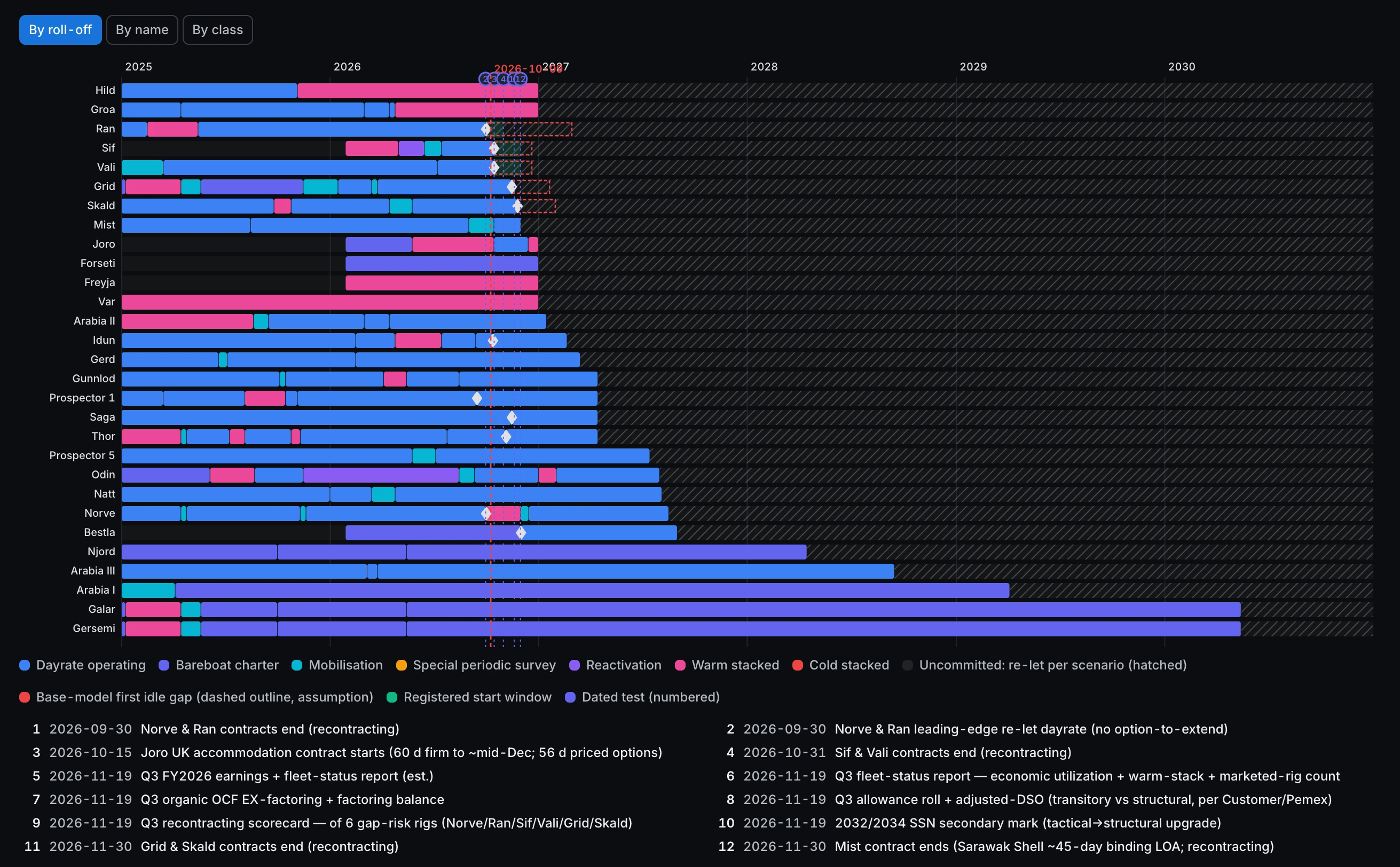
Each row is one rig. Blue shades are paid work (drilling or leased out) and pink is idle; dashed red boxes are the idle gaps the swarm expects before the next contract. The numbered markers are dated events the swarm's view will be judged against.
The swarm then checked its own finding and concluded that the evidence could not yet separate the two views, so it stopped describing the Q4 gap as an established call.
The decisive risks sit in documents most models never open
Much of the most valuable work came after the first thesis was set. It came from documents a typical model never touches, and it decided what shareholders would actually receive.
Cash flow was flattered by selling receivables
Reported net receivables rose just 0.4% in the first half. But Borr had sold $29.0M of receivables to a factoring company (none a year earlier) and set aside an $18.2M allowance. Adding both back, gross receivables grew 25%, and the company took about 91 days to collect, not the 73 reported. Without the factoring, first-half operating cash flow of +$26.3M would have been about −$2.7M.
A related trap sits in the next report. Borr sold its stake in its Mexican services venture in September. Viewing the stock as a short seller would, the swarm saw that the sale could make collection days look much better at the November results for structural reasons, not because Pemex paid faster. It set that up as a test, so a cleaner number is not mistaken for good news.
A loan covenant, not cash, is the binding constraint
The first test to bind in the swarm's base case is the revolving credit facility's book-equity covenant, not liquidity. Book equity was 26.0% of assets at June, against a 20% minimum. The headroom of $277.9M is about 9% of rig book value.
The annual report shows 13 rigs with impairment indicators, and the auditor flagged rig valuation as a critical audit matter. One non-cash write-down could trip the covenant without a dollar of cash leaving the company. That changes the most important question for management: would the banks waive the test?
The bonds quietly move value from shareholders to creditors
The model had subtracted Borr's 8.75% and 9.00% secured notes at face value in every outcome. But in the good outcomes, where Borr survives, bondholders keep an above-market coupon the company cannot call away until 2028–29: about 2.3 points over market on roughly $2.0B of notes. That makes the good outcomes about $0.40–0.50 a share less valuable to shareholders than the model had assumed.
Restructuring precedent cut both ways
- Survival odds were too low. The swarm's early reading of history said equity was wiped out in 7 of 7 offshore-driller downturns. That sample only included companies that went through Chapter 11. It left out those that restructured out of court, including Borr itself in 2020–22, after which the stock rallied from about $0.70 to about $4.50. On the corrected sample, 2 of 9 survived.
- The payout in a restructuring was too high. The model assumed old shareholders keep $0.10 a share if Borr restructures. Actual offshore-driller bankruptcy plans show old equity typically got only out-of-the-money warrants. Three separate estimates put the payout at about $0.03.
- The rescue raise rested on the wrong precedent. The model let Borr raise new equity worth up to 40% of its market value in a squeeze. The largest precedent, in May 2020, was backed by insiders and priced 14% above market, not a distressed raise. The cap was cut to 20%.
Customers hold an option on the backlog
National oil companies can suspend or cancel contracts when markets soften, which is exactly when survival is decided. Termination fees typically cover 50% to 100% of the remaining backlog, and some cancellations pay nothing. The swarm built in a loss of about 2% of contracted days per rig-year (range 1–4%), plus a 40% chance of a six-month Pemex suspension on three rigs in 2027.
Supply and tax cap the upside
- Stranded hulls. 10–16 modern hulls sit unfinished at shipyards. They can arrive well below the cost of a new build, which caps how high rates can run (−$0.05 to −$0.19 a share).
- A new tax regime. The model taxed Borr at a flat 4.3% of revenue. Bermuda's 15% corporate income tax and the OECD global minimum tax apply from 2026 (−$0.05 to −$0.20 a share).
Every signal at a glance
| Signal | Where it came from | Effect on value |
|---|---|---|
| Receivable sales flattered cash flow | Receivables note, factoring disclosure | Weaker liquidity |
| A divestment could flatter collection days | Divestment release | Test set for November |
| Book-equity covenant binds first | Credit facility terms, impairment note | Changed the key question |
| Restructuring sample was biased | Borr's own 2020–22 history | Better survival odds |
| Restructuring payout about $0.03, not $0.10 | Bankruptcy plans in SEC filings | Lower floor |
| Rescue raise capped at 20%, not 40% | Each precedent raise, classified | About −$0.01 |
| Above-market bond coupons | Bond agreement | −$0.40 to −0.50 in good outcomes |
| Rigs rolling off with no follow-on work | Rig-by-rig fleet status | Q4 EBITDA $56M vs Street $86M |
| Customers can cancel | Annual report contract terms | About −$0.09 |
| Pemex suspension risk | Customer exposure | −$0.02 |
| Stranded hulls | Shipyard supply data | −$0.05 to −0.19 |
| New tax regime | Annual report tax note | −$0.05 to −0.20 |
| Insider buying | Original filings | Against the view (see below) |
The swarm found and fixed errors in its own model, in both directions
The swarm's first valuation, on 17 September, came in at $4.13, with the stock at $4.33. The first challenge was to asset values. The model marked Borr's rigs at $160M, $130M and $95M, depending on age. Real transactions, including Borr's own purchase of five Noble rigs at about $72M each, and third-party appraisals of $70–115M pointed lower. The swarm re-marked the rigs to $110M, $85M and $70M, and fair value fell to $3.15.
On 18 September it set its first thesis at $3.25, against a share price of $4.46, and took no trade. Then it kept digging, and found errors in its own model in both directions:
| What the model had | What the swarm found | Direction |
|---|---|---|
| Six rigs leased out to other operators | Counted twice, as drilling revenue and again as lease income. Worth −$1.60 to −$1.80 a share. | Down |
| Operating cost of about $62k per rig per day | The annual report puts the all-in figure at $69.5–73.8k, about $10k a day more. | Down |
| A floor on equity value from selling the rigs | The bond terms block cash from reaching shareholders until the debt is repaid. | Down |
| "Only $44.2M of debt due before 2031" | The debt note shows $502.3M due before 2032, against $473.6M of liquidity. | Down |
| No reimbursable income | About $20M a year of net margin was missing. | Up |
| Maintenance capex of about $150–189M a year | The company guides to $60–70M. | Up |
| A claim of uncounted dilution from convertible bonds | The model already converted them. Adding it again would double-count. | Rejected |
The capex fix solved a puzzle. The swarm's model implied that Borr's secured notes should trade at 89.3 cents on the dollar, but the market had them near 97.9. Rather than conclude the bond market was wrong, the swarm looked for the error in its own model. Fixing capex moved the implied price to 93.1 cents, much closer to the market.
When the work stalled, the swarm measured the problem and rebuilt
Between 21 and 29 September, the swarm spent more time debating how to value Borr than establishing what it was worth. The fair values under debate swung widely:
The range of values under debate blew out, then collapsed after the rebuild Highest and lowest Borr fair value under debate in each stretch, $ per share, plotted on the stretch's last day.
| Date | Highest value under debate | Lowest value under debate |
|---|---|---|
| 20 Sep 2026 | $4.13 | $3.15 |
| 24 Sep 2026 | $3.40 | $2.42 |
| 26 Sep 2026 | $3.60 | $0.86 |
| 28 Sep 2026 | $4.10 | $1.16 |
| 29 Sep 2026 | $3.43 | $1.29 |
| 3 Oct 2026 | $2.65 | $2.42 |
| 9 Oct 2026 | $2.64 | $2.07 |
Marked events: 29 Sep 2026, Rebuild.
The swarm caught the problem and quantified it. A review of its own work found that:
- 55% of a week's work had gone into valuation method rather than new facts;
- it had raised 115 questions and answered 64;
- in about 27 hours, its central value had moved 7 times: $5.20 of gross movement for $1.50 of net change;
- 5 of those 7 moves were toward the share price, a sign it might be drifting toward the market;
- in one six-hour stretch, value had moved from $2.30 to $3.25 on changes to the model's structure, with no new evidence about Borr;
- a value it had flagged on 25 September as containing the double count stayed official until the rebuild.
Three changes followed:
- A price-blind rule. A move in the share price is treated as price, not as evidence about value.
- A shorter question list. Every open question was sorted by whether its answer could change the call before the 19 November results. The list fell from 72 to 33.
- A rebuild instead of another patch.
On 29 September, the swarm rebuilt the model from the ground up: every rig modelled quarter by quarter with full financial statements, every bank and bond covenant tested in every scenario, the long-run dayrate treated as a range of 19 outcomes fitted to 35 years of history, and 414 assumptions, each with its source.
From then on, every change to fair value was logged with the input it moved, the source behind it and its dollar effect. The spread of values under debate narrowed from about $3 to about 60 cents.
Fair value fell as the swarm corrected its model; the share price rose Borr Drilling, $ per share: the swarm's fair value vs the daily closing share price.
| Date | Swarm fair value | Note |
|---|---|---|
| 17 Sep 2026 | $4.06 | First valuation ($4.13), then two quick revisions |
| 18 Sep 2026 | $3.25 | Rig values re-marked from new-build prices to real secondhand sales; first thesis set with the stock at $4.46 |
| 19 Sep 2026 | $3.21 | |
| 20 Sep 2026 | $3.36 | Last change to the old model. The swarm flagged it as wrong on 25 Sep but left it in place until the rebuild |
| 28 Sep 2026 | $3.36 | |
| 29 Sep 2026 | $2.42 | Rig-by-rig rebuild: six leased rigs had been counted twice and daily costs ran about $10k too low |
| 30 Sep 2026 | $2.47 | |
| 1 Oct 2026 | $2.54 | |
| 2 Oct 2026 | $2.64 | Contract history checked against original filings widens the dayrate range |
| 3 Oct 2026 | $2.64 | |
| 4 Oct 2026 | $2.46 | Restructuring payout to old shareholders cut from $0.10 to $0.03 on actual offshore-driller bankruptcy plans |
| 5 Oct 2026 | $2.44 | |
| 6 Oct 2026 | $2.38 | National-oil-company contract cancellation risk added |
| 7 Oct 2026 | $2.21 | Bonds valued at the payments they actually promise, not face value |
| 8 Oct 2026 | $2.07 | Audit from scratch: every number reproduced, four issues fixed |
| 9 Oct 2026 | $2.07 |
BORR share price: $4.36 on 15 Sep 2026, $4.78 on 9 Oct 2026 (19 observations).
Marked events: 25 Sep 2026, Error flagged; 29 Sep 2026, Rebuild; 8 Oct 2026, Audit.
On 8 October, the rebuilt model was audited from scratch. The audit reproduced the headline value to six decimal places and passed all 116 checks. It then raised 14 findings. Four changed the value:
| Finding | What was wrong | Effect on fair value |
|---|---|---|
| Long-run dayrates held flat for decades | History says dayrates drift back to the long-run average, with a half-life of about 4 years. Holding a cyclical level flat treated the cycle as permanent. | −$0.22 |
| An assumed early bond buyback | Buying the bonds back early only pays if Borr can refinance near 6.4%. At the roughly 9.4% it would actually pay, it never does. | −$0.10 |
| The credit line lapsing in 2031 in every outcome | A driller that passes its lenders' tests normally renews its facility. | +$0.04 |
| Fire-sale discounts in a going-concern value | Forced-sale discounts belong only in the restructuring outcomes. | +$0.14 |
The swarm accepted most findings and sent a few back for more evidence. After smaller fixes, fair value settled at $2.07.
Good research states the evidence against its own view
A model that values a stock at $2.07 when it trades at $4.61 should be asked what the bond market thinks. The swarm asked.
The swarm sees more near-term default risk than the bond market does Borr Drilling, cumulative chance of default (%): the swarm's model vs what bond prices imply. By 2035 the two cross.
| By end of | Swarm model | Implied by bond prices |
|---|---|---|
| 2028 | 34.5% | 19.3% |
| 2030 | 52.4% | 33.3% |
| 2032 | 52.4% | 45.0% |
| 2035 | 52.4% | 58.7% |
- Over the next few years, the swarm is more pessimistic than credit investors: a 34.5% chance of default by the end of 2028, against about 19% implied by bond prices.
- Over the longer run the two converge, and by 2035 the bond market's implied default risk is higher.
- The model priced Borr's 2032 and 2034 notes at 85.1 and 85.6 cents, against market prices of 95.65 and 91.68.
When one of its own analyses claimed the share price "says the same" as the swarm, the swarm withdrew the line. Both the stock and the bonds price a better outcome than the swarm does, and it says so.
Insiders were buying
The founder and CEO bought $17.7M of stock as the swarm's value fell toward $2 Open-market buying by the founder's holding company and the CEO, $M: 4.2 million shares at an average of $4.22.
| Label | Value |
|---|---|
| 16 Sep | 4.3 |
| 17 Sep | 0.66 |
| 18 Sep | 0.2 |
| 5 Oct | 6.2 |
| 6 Oct | 6.36 |
Between 16 September and 6 October, Borr's founder, through a holding company, and its CEO bought 4.2 million shares for $17.7M. With the 6 October purchase, the founder crossed 10% of the company, and board-linked holders now control about 23%.
Research looking only for confirmation would have ignored this. The swarm did three things instead:
- Sourced it. Every US filing was matched to the Oslo exchange notice, to the share and the cent.
- Sized it. Academic studies of insider buying point to a +3% to +9% abnormal return over the following 6–12 months, adjusted here for a founder known to support the stock.
- Tested it. It put a 55% chance on Borr beating an equal-weight basket of its four peers between 5 October 2026 and 5 April 2027.
It treated the buying as real evidence against its view. It did not flip the view, and it did not explain the buying away.
A low fair value does not make a good short
Half the probability sits where the equity is worth little; most of the value sits in the upside tail Borr Drilling: chance of each long-run dayrate outcome vs its share of fair value (%).
| Category | Chance of this outcome | Share of fair value |
|---|---|---|
| Below $120k a day | 52.4% | 1.2% |
| $125k–135k a day | 21.5% | 16.2% |
| $140k–145k a day | 8.5% | 18.8% |
| $150k a day or more | 17.5% | 63.8% |
In just over half the outcomes, debt absorbs almost everything: together they account for 1% of fair value. Almost two-thirds of the value comes from the 17.5% chance that dayrates reach $150k a day or more.
With fair value at $2.07 and the stock at $4.61, a short looks obvious. Four things stopped the swarm:
- The method calls every driller expensive. Applied to Transocean, Valaris, Noble and Seadrill, the swarm's valuation method put each below its share price: 0.33x, 0.47x, 0.57x and 0.68x, with Borr at 0.32x. "Worth less than the price" says something about the method, not only about Borr.
- The market is not paying a premium. On the Street's forecasts, Borr trades at 6.63x mid-cycle EBITDA, against a peer median of 6.54x, despite net debt of 4.25x EBITDA against 0.65–1.09x at Valaris, Noble and Seadrill. The market is underwriting the Street's earnings path. The swarm's edge rests on one forecast, not on a mispricing it can lean on.
- Both credit and equity markets price a better outcome, and the people who know the company best were buying.
- The payoff is lopsided. A short on a levered option on the rig cycle loses most when the market is most wrong about the cycle, and that is the one thing nobody can yet know.
Its recommendation is flat, with high conviction: confident there is no trade worth taking today, with dated events that would change that. They are a Pemex contract award, the October–November rig re-contracts, the 12 November fleet status report and the 19 November results. It puts a 90% chance on still being flat on 30 November, whatever those events show.
Every view comes with predictions that reality will grade
Most of the swarm's 109 predictions are graded at the November results Borr Drilling swarm: dated predictions by when they are graded, as of 9 October.
| Label | Value |
|---|---|
| Already graded | 13 |
| Voided by the rebuild | 5 |
| Due Oct 2026 | 3 |
| Due Nov 2026 (results) | 67 |
| Due Dec 2026 to Jun 2027 | 19 |
| Due later | 2 |
On the 13 predictions graded so far, the swarm's accuracy score (the Brier score, where lower is better) is 0.137. Always guessing 50-50 would score 0.25.
| The swarm said, beforehand | What happened | Verdict |
|---|---|---|
| The rig Norve finds no new work within 30 days of its contract ending (82%) | Its next job starts on 15 December. | Right |
| Historical cost pass-through, checked against original filings, lands inside the swarm's estimated band (65%) | 0.18, inside 0.15–0.30. | Right |
| Consensus 2028 EBITDA implies a fleet dayrate at or above $128k (75%) | It does. | Right |
| 1997–2005 contract data shows less dayrate variation than the model assumed (65%) | It showed more. The swarm widened its dayrate range. | Wrong |
| A disagreement over credit modelling resolves one particular way (70%) | It resolved on timing instead. The worst miss so far. | Wrong |
The misses stay on the record next to the hits. What gets graded at the November results:
| Prediction | Probability |
|---|---|
| None of Borr's five idle rigs announces a new contract by the 19 November fleet status report | 73% |
| Borr discloses at least one new suspension or early termination outside Mexico | 35% |
| A Borr rig wins the pending Pemex tender | 33% |
| Borr outperforms its four-peer basket from 5 October 2026 to 5 April 2027 | 55% |
| The swarm's own fair value is higher on 30 November than on 4 October | 50% |
The last is a test the swarm set for itself. If its fair value were drifting in a predictable direction, it would be under-reacting to evidence. Setting the odds at 50% commits it to having its number in the right place now, rather than walking it slowly toward the price.
Management's time is saved for questions only management can answer
The swarm wrote 54 questions for management and 40 for industry experts. Each records, before anyone asks, what the swarm believes now, which input the answer would change, and what answer would move its view. As the research moved on, 30 were dropped and 13 were answered by the research itself.
Three examples:
Borr Drilling, for management
"On the same dayrate-equivalent basis you used for 2026 (73% covered at about $134k a day), what share of 2027 available rig-days is now contracted, and what is the average dayrate on that 2027 book excluding mobilisation fees?"
Borr Drilling, for management
"How much headroom do you expect on the revolver's 20% book-equity test through 2030 if 2027-28 re-lets land 5-10% below current rates, and if it tightened, would you seek a waiver or amendment from the revolver lenders before raising equity, sell stacked rigs, or let the undrawn revolver lapse while the notes stay outstanding?"
Borr Drilling, for management
"On South-East Asia, with Skald, Mist, Idun, Saga, Gunnlod and Thor coming off contract between November and April, how do you avoid bidding your own rigs against each other, and which of them have follow-on work in sight?"
Questions also sharpen as the research advances. One on contract cancellation went through three versions:
Borr Drilling, for management, contract-cancellation risk
First version:
"Which of today's firm contracts carry termination-for-convenience or national-oil-company statutory termination rights, what early-termination fee applies, and how many suspension or termination notices has Borr received since 1 July 2026?"
After more research, the swarm added:
"…Separately: who was the sanctioned customer behind the two 2025 terminations, and is any of that exposure linked to the Pemex conduit?"
Once the swarm had found the answer itself, the question became a confirmation. The final version names the two rigs and the customer, and asks whether any other contract carries similar language.
The swarm does not spend management's time on anything it can find on its own.
What this means for investment teams
Borr is one of the three swarms in Introducing Matterfact Agent Swarms, and the most intensive of the three. Four lessons stand out.
In levered, cyclical stocks, the edge is in the plumbing. Covenants, call protection, receivable sales, cancellation rights and restructuring precedent decide what shareholders actually receive. Almost every decisive signal here came from documents most models never open.
Coverage no longer forces a choice between breadth and depth. One mid-cap driller required rig-by-rig contract history, 35 years of dayrates, the full debt stack and bankruptcy precedent. A swarm covers all of it at once, and keeps covering it as new filings arrive.
Self-correction is what makes the output usable. The swarm found errors worth more than a dollar a share in its own model, caught itself drifting toward the market price, rebuilt, and had the result audited from scratch. Every change to fair value traces to a specific fact: a contract award, a bond term, a restructuring precedent, an audit finding.
Knowing when not to trade is part of being right. The swarm thinks the market is overpaying for an upcycle, 62% against its 26%. But the bonds price a better outcome, insiders are buying, and its own method calls every driller expensive. So it stays flat, and it has written down exactly what would change its mind.
On 19 November, Borr reports, and 67 of the swarm's predictions are graded in public.
Read the swarm's investment memo
The swarm's investment committee memo, dated 9 October 2026, sets out the full case in the format a portfolio manager would expect: the recommendation, valuation and scenarios, the balance sheet and covenants, catalysts and the tests set in advance, risks to the view, and how every number was verified.
kind: word
title: Borr Drilling investment memo
meta: Written by the agent swarm · 9 October 2026 · Word, 38 KB
href: /samples/borr-drilling-ic-memo-2026-10-09.docx
This post and the investment memo describe research outputs from a Matterfact agent swarm, shown to illustrate how the system works. They are not investment advice or a recommendation to buy or sell any security. Any trades or stances described are hypothetical model outputs, not actual trades.