Blog · · Ashutosh Agarwal
Matterfact M&A Agent: Expert-built merger arbitrage analysis, from break prices to approval timelines
Matterfact M&A Agent runs dedicated M&A skills, built by experts and tuned on real deals, to analyse an announced merger the way an event-driven desk does: it prices the break from the unaffected stock, lays out every approval with its date and works out what each holder receives, with results that match the filings and the regulators' published numbers.
Ask an AI model whether a merger arbitrage trade is worth putting on and you will usually get a spread, an annualised return and a confident close probability. What you rarely get is the part that decides the trade: where the target trades if the deal dies, which approvals stand between signing and close, and what a holder actually receives once collars, elections and contingent payments are counted. A spread tells you what the market thinks. It does not tell you why, or whether you should disagree.
Matterfact M&A Agent is built on dedicated skills for M&A analysis, expert-built and tuned on real mergers. It answers those three questions on any announced deal, with every term traced to the merger agreement, the proxy or a regulator's docket. On the deals below, the numbers match the public record: a bank-competition screen that reproduces the Federal Reserve's own published figures, a prorated election that matches what holders were paid, and a break price that changes the expected value of a live trade by about a third.
This article sets out what Matterfact M&A Agent delivers on a deal, using real 2024–26 mergers: Paramount and Warner Bros. Discovery, Fifth Third and Comerica, Blackstone and TXNM Energy, Union Pacific and Norfolk Southern, Sunoco and Parkland, Pfizer and Metsera, and Kroger and Albertsons.
TL;DR
- Matterfact M&A Agent runs dedicated, expert-built skills for M&A analysis. They cover merger arbitrage, deal structure and the regulators, and they are tuned on real 2024–26 deals.
- General-purpose AI falls short on M&A work. In 2026 benchmarks, the best frontier model met 58% of bankers' criteria on M&A tasks, and every model forecast deal outcomes less accurately than the spread.
- Matterfact M&A Agent prices the break from the unaffected stock. On Warner Bros. Discovery, that cut the trade's expected value from +9.9% to +6.3% at the same close odds.
- Every approval goes on one timeline. The deals here needed two to six approvals, from state attorneys general to the Fed, the rail regulator and a state utility commission.
- Deal terms come from the merger documents. On bank deals, Matterfact M&A Agent matched the Fed's Fifth Third and Comerica order to within one point in every market.
- The payoff reflects what each holder receives. An all-cash Parkland election paid about C$21.82 plus 0.270 units, not C$44.
1. General-purpose AI falls short on merger analysis
Public benchmarks published in 2026 measure the gap, and they agree. In BankerToolBench, investment bankers from leading firms graded nine frontier models on real banking workflows against more than 100 criteria per task. On the 62 M&A tasks, the best model met 58% of the criteria (Exhibit 1), and bankers rated none of the best model's work ready to send to a client. Merger models were among the hardest tasks: in one, the leading model added cost synergies to revenue instead of cutting operating expenses. Halluminate's Westworld Finance Diligence Bench, a NeurIPS 2026 benchmark of acquisition due diligence, found the same ceiling: across seven frontier models, the best average score was below half the available credit.
Exhibit 1
On M&A work graded by investment bankers, the best general-purpose model met 58% of the criteria.
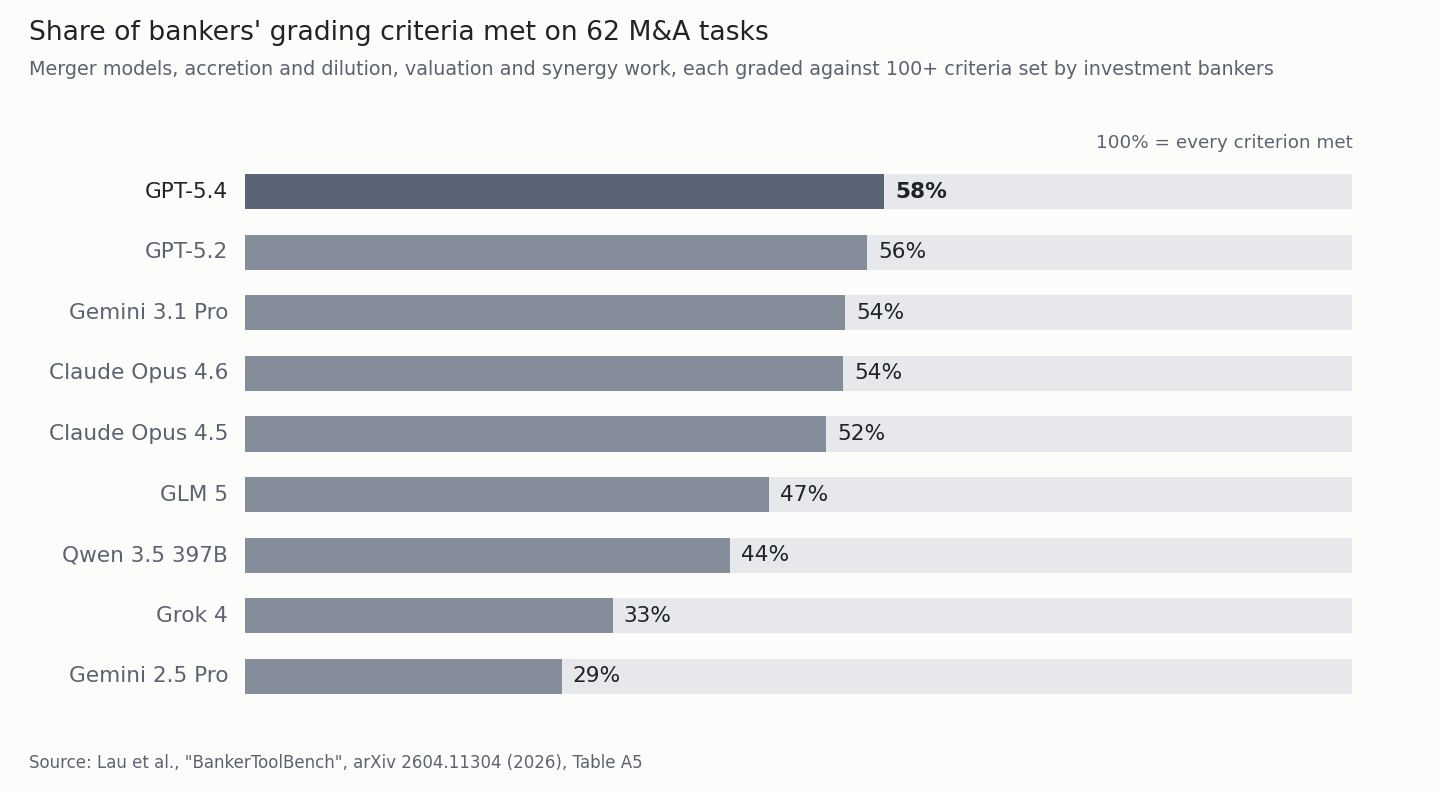
Note: Each task is graded against a rubric of more than 100 weighted pass or fail criteria written by investment bankers; the score is the weighted share passed, averaged over three runs. These are the study's results, not Matterfact's.
Source: Lau et al., "BankerToolBench: Evaluating AI Agents in End-to-End Investment Banking Workflows", arXiv 2604.11304 (2026), Table A5; Alward et al. (Halluminate), "Westworld Finance Diligence Bench: Evaluating AI Agents on Long-Horizon Enterprise Work", NeurIPS 2026 workshop
The same holds for the question an arbitrage desk asks. In a study accepted to ICML 2026, researchers asked general-purpose models to forecast the outcomes of more than 400 announced deals across 42 countries: close at the agreed terms, close at a higher price, or terminate. Every model forecast less accurately than the market's own odds, read straight from the spread. A system built on expert-designed deal research and training on historical deals had 24% less error than the market (Exhibit 2).
Exhibit 2
Every general-purpose model forecast merger outcomes less accurately than the spread itself; expert-built deal analysis beat both.
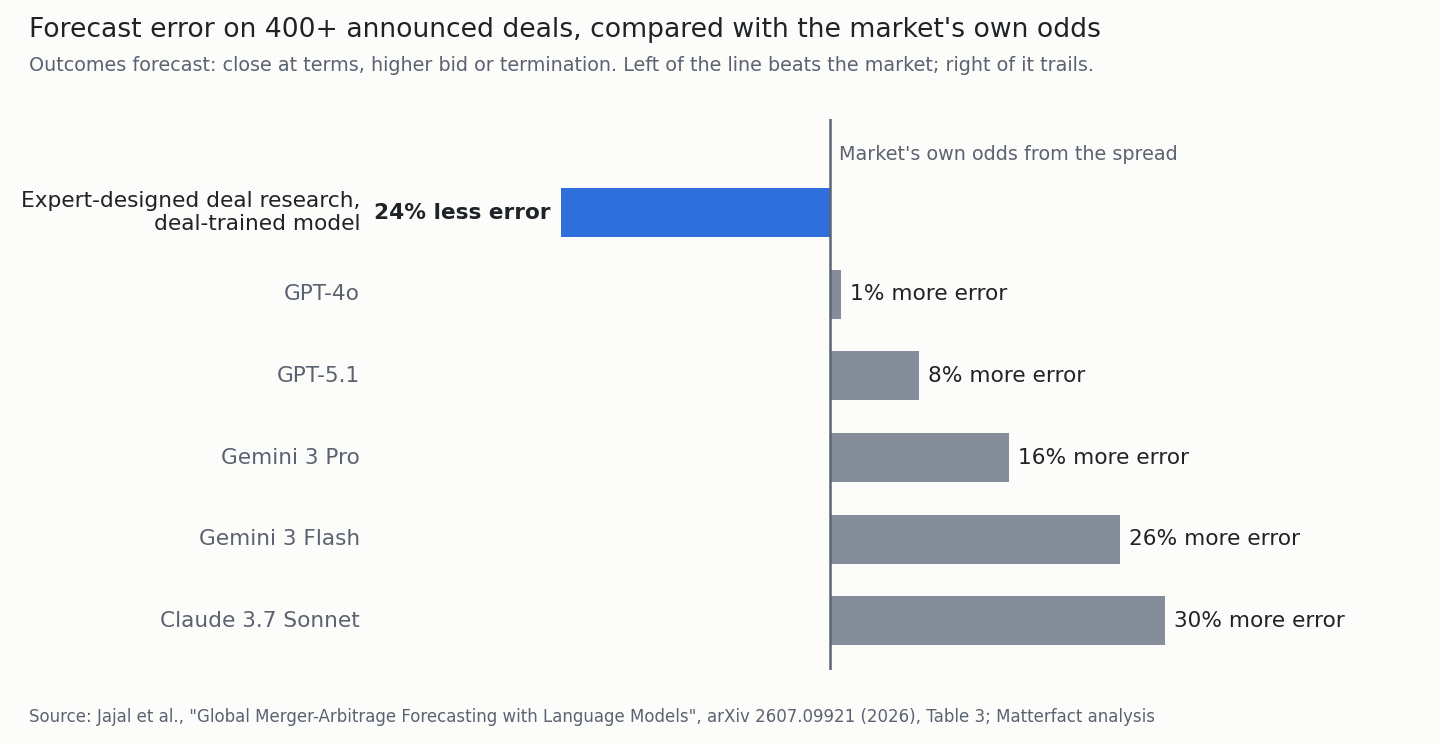
Note: Error is the class-balanced Brier score across the three outcomes on an out-of-sample set of large deals, shown relative to calibrated market-implied odds (0.199). Raw scores: expert-designed system 0.151; GPT-4o 0.201; GPT-5.1 0.214; Gemini 3 Pro 0.231; Gemini 3 Flash 0.250; Claude 3.7 Sonnet 0.259. These are the study's results, not Matterfact's.
Source: Jajal et al., "Global Merger-Arbitrage Forecasting with Language Models", arXiv 2607.09921 (2026), Table 3; Matterfact analysis
The authors of both studies point to the same remedy: domain expertise built into the system, not a larger general model. That is the approach behind Matterfact M&A Agent. The same pattern holds across finance work: on a public benchmark of finance tasks, the same model scored 17 points higher inside Matterfact's agent than in the benchmark's own setup.
2. Matterfact M&A Agent prices the break from the unaffected stock, so the market's odds come out right
Matterfact M&A Agent starts every merger answer with the close probability the market is already pricing. A target trades at a weighted average of two outcomes: the deal value if it closes and the break price if it does not. Solve for the weight and you have the market's odds; an arb view is a disagreement with that number, with a named reason.
The answer depends on the break price, and the common shortcut, assuming the target falls about 20% from today's price, is wrong in a predictable way. Today's price already contains the deal. Matterfact M&A Agent builds the break price from the price before the first credible report, adjusts it for how comparable stocks have moved since, and adds any fee the buyer would owe the target if regulators block the deal, weighted by the chance it is paid.
Asked about Paramount's $31 cash offer for Warner Bros. Discovery as of 20 July 2026, a week after 12 states sued to block it, Matterfact M&A Agent anchored on Warner's $12.54 close the day before the first report of Paramount's interest, added the $7 billion regulatory fee (about $2.79 a share, which an injunction from the states' suit would trigger) and set the break price at about $17. The shortcut would have put it near $20.70 (Exhibit 3).
Exhibit 3
At the same 75% close odds, the shortcut made the Warner Bros. Discovery trade look about 50% more attractive than it was.
| Break price method | Break price | Market-implied odds of closing | Expected value at 75% odds |
|---|---|---|---|
| Today's price less 20% | $20.69 | 50% | +$2.56 a share (+9.9%) |
| Matterfact M&A Agent: unaffected price, peer drift and the regulatory fee | about $17 | about 63% | +$1.64 a share (+6.3%) |
Note: Warner Bros. Discovery at $25.86 on 20 July 2026 against a $31.00 cash deal value. Implied odds = (price − break price) / (deal value − break price).
Source: Warner Bros. Discovery DEFM14A and 8-K filings; Matterfact M&A Agent, as of 20 July 2026; Matterfact analysis
The shortcut errs in both directions at once: it makes the market look more pessimistic than it is (50% against about 63%), so any view of your own looks like a bigger edge, and it shrinks the loss on a break. Matterfact M&A Agent's view on that date was that the market was underpricing a settlement with the states. The deal closed on 6 October 2026, after Paramount settled in September.
3. Every approval goes on one timeline, with the one that sets the close date named
Most AI deal answers treat regulatory risk as an antitrust question: market shares, concentration, the federal waiting period. In the deals here, antitrust was often not the approval that decided the outcome or the date. Matterfact M&A Agent identifies every approval a deal needs, gives each its legal test, clock, status and date, and names the one that sets the close.
- Paramount and Warner Bros. Discovery had cleared federal antitrust review, then faced a 12-state suit and a court order pausing the deal. Matterfact M&A Agent named the states as the long pole.
- Union Pacific and Norfolk Southern need the Surface Transportation Board. Matterfact M&A Agent dates the decision from the Board's own schedule: the application was rejected as incomplete in January 2026 and accepted in revised form in May, and final briefs are due in May 2027, with the decision due within 90 days of the record closing.
- Blackstone and TXNM Energy had every approval except New Mexico's utility commission, the same commission that rejected a sale of the same utility in 2021. Matterfact M&A Agent weighs that precedent against what is different this time.
- Fifth Third and Comerica needed the Federal Reserve and the OCC, which test competition on deposits in each local banking market.
The slowest approval sets the close date, and the close date sets the annualised return. Matterfact M&A Agent also lists the dated events that would change the answer: a hearing examiner's recommendation, a state lawsuit, a second information request, a deadline extension.
4. Deal terms come from the merger documents, including later amendments
Deal terms move after signing, and the press release is not the contract. Matterfact M&A Agent reads the merger agreement, the proxy, tender documents and later amendments, so the analysis uses the terms in force today.
In July 2026, after New Mexico's commission voided a $400 million share sale from Blackstone to TXNM, the parties agreed that neither could walk away before 31 May 2027, and TXNM gave up half of the $350 million fee Blackstone would owe it if regulators blocked the deal. A break price built on the original fee is wrong by about $1.60 a share. Paramount's agreement added $0.25 a share for every quarter the deal ran past 30 September 2026, and the final payment of $31.0167 a share included it.
For bank deals, Matterfact M&A Agent computes deposit concentration market by market from FDIC data. Run on the Federal Reserve's own definitions of the local banking markets, it reproduced the figures in the Fed's approval order for Fifth Third and Comerica (Exhibit 4).
Exhibit 4
On the Fed's market definitions, Matterfact M&A Agent matched the Fed's Fifth Third and Comerica order to within one point in every market.
| Banking market | Fed order: concentration after the deal | Fed order: change | Matterfact M&A Agent: concentration after | Matterfact M&A Agent: change |
|---|---|---|---|---|
| Calhoun County, Michigan | 2,001 | +524 | 2,001 | +525 |
| Jackson, Michigan | 1,935 | +157 | 1,935 | +157 |
| Grand Rapids, Michigan | 1,071 | +75 | 1,071 | +76 |
Note: Concentration is the Herfindahl-Hirschman index of deposits, using June 2025 FDIC Summary of Deposits data, with thrift deposits weighted at 50% as the Fed does. The Fed then counted local credit unions and one business-lending thrift in Calhoun County, which brought the change to +238, and required no branch sales.
Source: Federal Reserve Order No. 2026-02 (13 January 2026); FDIC; Matterfact analysis
5. The payoff reflects what each holder actually receives
Headline consideration is often not what a shareholder gets, and the difference changes both the payoff and the hedge. Matterfact M&A Agent works out the payoff before the spread.
- Elections are prorated. Parkland holders could elect C$44 in cash for each share. Cash was heavily oversubscribed, so an all-cash elector received about C$21.82 in cash plus 0.270 new SunocoCorp units, and because those units did not trade until after closing, the hedge had to be the existing Sunoco LP units.
- Contingent value rights are a range, not a maximum. Pfizer's final Metsera price was $65.60 in cash plus a non-transferable right to up to $20.65 more, paid only if three milestones were met by deadlines running to 2031. Matterfact M&A Agent values each milestone by its probability and deadline, and treats Novo Nordisk's rival bid as upside for Metsera's holders, not as break risk.
- Dividends change the deal value. Kroger's $34.10 offer for Albertsons became $27.25 in cash at closing once Albertsons paid a $6.85 special dividend in 2023.
- Mixed and collared deals change the hedge. For Union Pacific's offer of one share plus $88.82 in cash for each Norfolk Southern share, only the share leg is hedged. In a collared deal, Matterfact M&A Agent reads which kind of collar the agreement uses, because one kind needs the full share hedge inside the price band and the other needs almost none.
Five questions to ask of any AI merger analysis
Research heads choosing an AI tool for merger arbitrage, including ours, can test any answer with these:
- What break price did it use, and was it built from the unaffected price or from today's?
- What odds of closing is the market implying, and what named risk explains any disagreement?
- Which approvals does the deal need, and which one sets the date?
- Which document did each term come from, and has it been amended?
- What does a holder actually receive once elections, collars, contingent payments and dividends are counted?
Matterfact M&A Agent draws on SEC filings, court dockets, the Federal Register, FDIC data and market prices, alongside the more than 5,000 skills and 400+ playbooks in Matterfact's agent. If your desk trades announced deals, take a live deal you know well and ask Matterfact M&A Agent the five questions above.