Blog · · Ashutosh Agarwal
Introducing News Read-Throughs
The news that moves a stock is often about another company. Read-throughs, new in Matterfact News, find those stories for every name you cover, judge what each one means for that name, and show how the stock took it.
TL;DR
- New in Matterfact News: read-throughs. Matterfact reads the news on every competitor, supplier and customer of the names you cover, judges each story separately for each name, and shows how the stock has traded since
- Much of the news that moves a stock is about another company: a customer's spending plan, a supplier's capacity, a competitor's contract or a rule that reaches a whole industry
- Markets are slow to connect linked companies. More than a decade of academic research finds that news about customers, suppliers and technology peers reaches a stock's price with a lag
Coverage lists are organized by ticker. The news that moves those tickers is not. When a cloud provider raises its plan for GPU capacity, the chip and networking companies that sell to it share in the demand. When one semiconductor equipment maker warns about new export rules, its competitors face the same rules. When a memory supplier sells out next year's output, its largest customers learn something about their own supply.
Analysts call these read-throughs, and the most valuable ones are rarely in the headline about the company you cover. They sit one link away. The research is consistent on what happens next: when news breaks at a company's customer, supplier or technology peer, the linked company's stock tends to respond with a delay, because investors' attention is organized around the companies they already follow.
Yet the reading load has outgrown the desk. In earlier work we counted 28 companies that matter to a single German automaker. Across a coverage list of 20 or 30 names, the news that matters is spread over hundreds of companies, and most of their stories have no bearing on the names you cover.
Today we are launching read-throughs in Matterfact News to do that reading for you. For every name you cover, Matterfact reads the news on its competitors, suppliers and customers, decides which stories matter to that name and why, and shows how the stock has traded since each one broke. Everything else waits in Peer news.
This article sets out why read-throughs slip past even careful desks, how the new feature finds and judges them, and how analysts can put it to work before the open and through the session.
The news that moves your names is often about someone else
Four strands of research, published over more than a decade, point the same way.
- Customers and suppliers. Lauren Cohen and Andrea Frazzini linked companies to their principal customers and found that suppliers' share prices do not promptly reflect news at those customers. A strategy that bought suppliers whose customers had just done well, and sold those whose customers had done badly, earned monthly alphas of over 150 basis points.1
- Related industries. Lior Menzly and Oguzhan Ozbas found that returns in supplier and customer industries predict each other's returns, and that the effect is weaker where more analysts and institutions follow the stocks.2
- Technology peers. Charles Lee and his coauthors linked companies by the similarity of their patent portfolios. The returns of a company's technology peers predicted its own returns, with a monthly long-short alpha of 117 basis points.3
- Shared analysts. Usman Ali and David Hirshleifer showed that one measure of connection, two companies covered by the same sell-side analysts, explains the customer, supplier, industry and technology effects above. Analysts themselves were slow to update on news about linked companies.4
The common thread is attention. The news is public. What lags is the connection between the story and the company it touches. Later studies suggest some of these effects have narrowed since they were published, which raises the bar rather than lowering it: the advantage goes to the desk that makes the connection first, not to the one that reads about it in the next morning's note.
Three reasons read-throughs slip past a careful desk
News is filtered by ticker. A terminal or feed set to your coverage list shows stories tagged with your tickers. A story about your name's largest customer is usually tagged with the customer's ticker, so it may never reach your screen.
The wider universe is too large to read. Adding every competitor, supplier and customer to the filter closes one gap and opens another. The feed fills with hundreds of headlines a day, and most of them do not matter to the names you cover.
Relevance belongs to the pair, not the story. The same headline can be material for one name and noise for its neighbor. A cloud provider's higher capex plan reaches a GPU maker through demand, reaches a memory maker through supply, and may not reach a PC maker at all. Deciding means reading each story against each link, which is the work no team has time to do at scale.
Taken together, these gaps explain why read-throughs are so often found after the fact: in a sell-side note the next morning, or in a move the desk cannot explain.
Every story is judged against every name it might touch
Read-throughs in Matterfact News work in three steps.
- Map who is connected. Each name you follow comes with its competitors, suppliers and customers, from Matterfact's map of who sells to whom. The links are rarely spelled out in one place. US public companies must disclose when a single customer accounts for 10 percent or more of revenue, but they need not say who it is.5
- Judge each story for each name. When one of those companies makes news, Matterfact reads the story with what it knows about the link and about your company, and decides whether it matters to that name.
- File it and grade it. A story that matters is filed under the channel it travels through and graded for how much. The rest wait in Peer news, out of your way.
The result is a feed in which every row says who the story is for and where it came from: "Read-through for NVDA · from Oracle, a customer" (Exhibit 1).
Exhibit 1
One story about a customer reaches three of the names you cover.
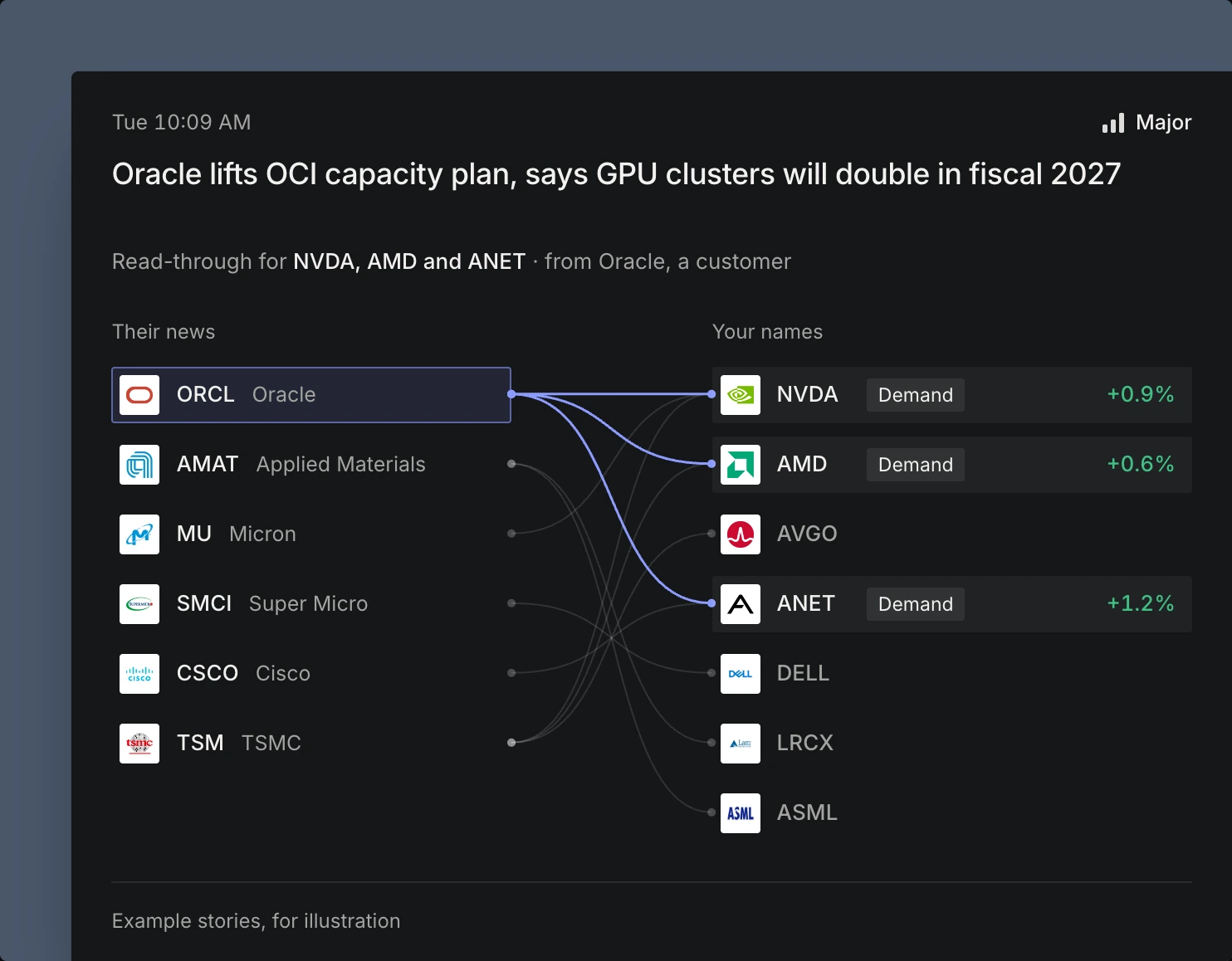
Note: Example stories and price moves, for illustration.
Source: Matterfact News
The judgment is made separately for every linked name. In the example, the same story is a high-confidence read-through for two names, a medium-confidence one for a third, and not material for a fourth, which stays in Peer news (Exhibit 2).
Exhibit 2
Each story is judged separately for every name linked to the company in the news.
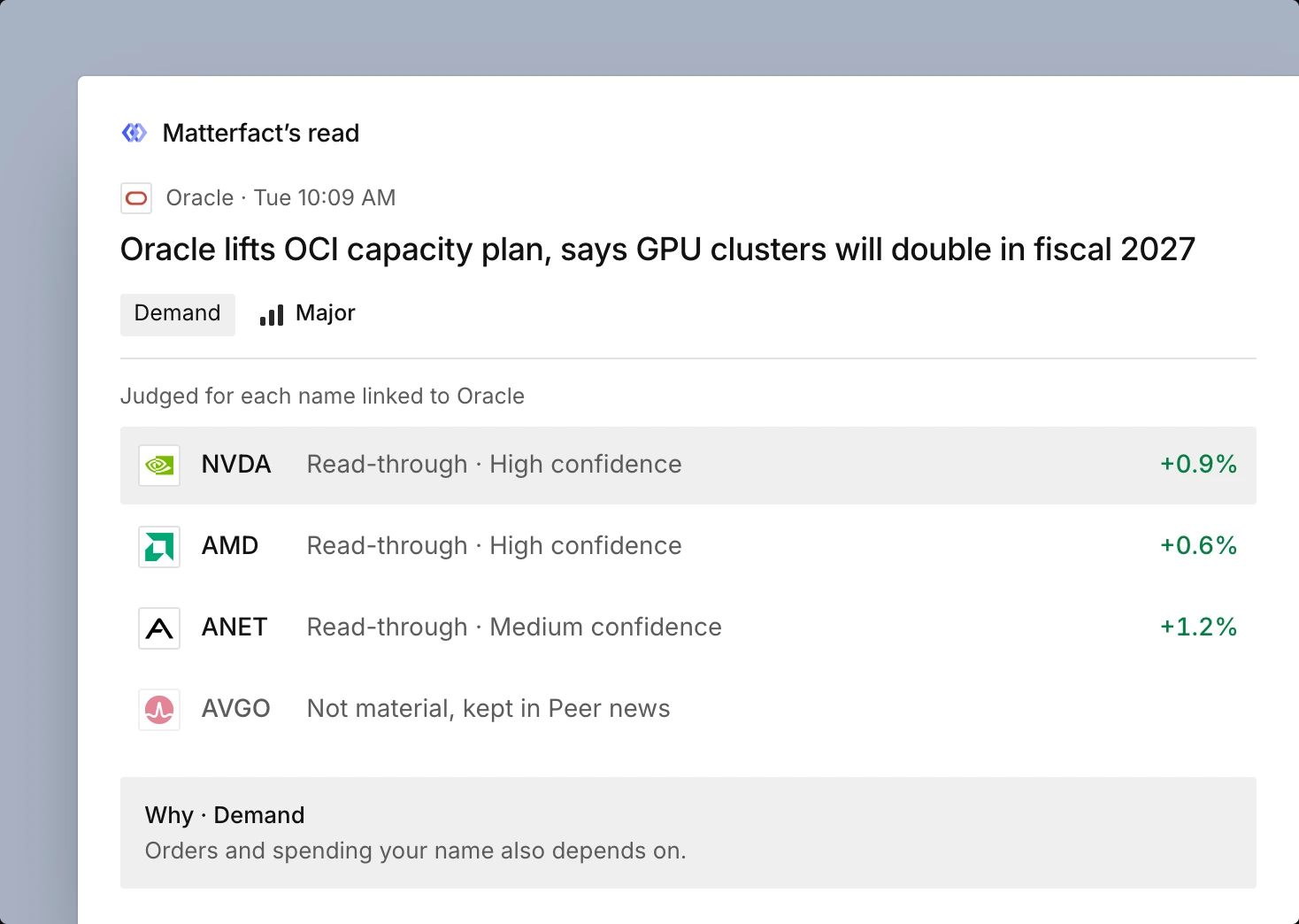
Note: Example story and price moves, for illustration.
Source: Matterfact News
Eight channels and four grades
Every read-through is filed under the channel through which the story reaches your name (Exhibit 3).
Exhibit 3
A story about one company reaches another through one of eight channels.
| Channel | How the story reaches your name | For example |
|---|---|---|
| Demand | Orders, volumes or spending your name also depends on | A cloud provider raises its GPU capacity plan |
| Supply | Capacity, shortages or input costs your name relies on | A memory maker sells out next year's output |
| Pricing | Prices or discounts in a market your name sells into | A rival cuts list prices on a competing product |
| Market share | Contracts, customers or products won or lost that your name competes for | A competitor loses a large carrier contract |
| Customer | A customer's or supplier's capex, budgets, sourcing or inventory | A retailer cuts its inventory targets |
| Regulation | Rules, tariffs or rulings that also apply to your name | New export rules hit one equipment maker |
| Technology | Shifts in technology or products that change your name's position | A rival ships a faster switch chip |
| Comparable | Deals, valuations or results the market will apply to your name | A peer is taken private at a premium multiple |
Source: Matterfact News
Each read-through also carries a grade for how much the story matters to investors in the company it is about: Routine, Minor, Notable or Major. A Notable-only view keeps the last two. And each carries Matterfact's confidence in the link, high, medium or low, so it is always clear why a story made your feed.
The question is whether it is already in the price
A read-through is only useful if you know whether the market has acted on it. Every row in Matterfact News carries the move of the name the story is for, from the price just before the story to the close of the first session that traded after it:
- Before the open: measured from the previous close.
- During the session: live, until the close.
- After the close: measured through the next session.
For a read-through, the move shown is your name's, not the other company's. Market-wide macro stories show SPY. Open any story and both companies are set to zero at the moment it crossed, on one-minute prices (Exhibit 4).
Exhibit 4
Both stocks start from zero when the story crosses, so the reaction reads at a glance.
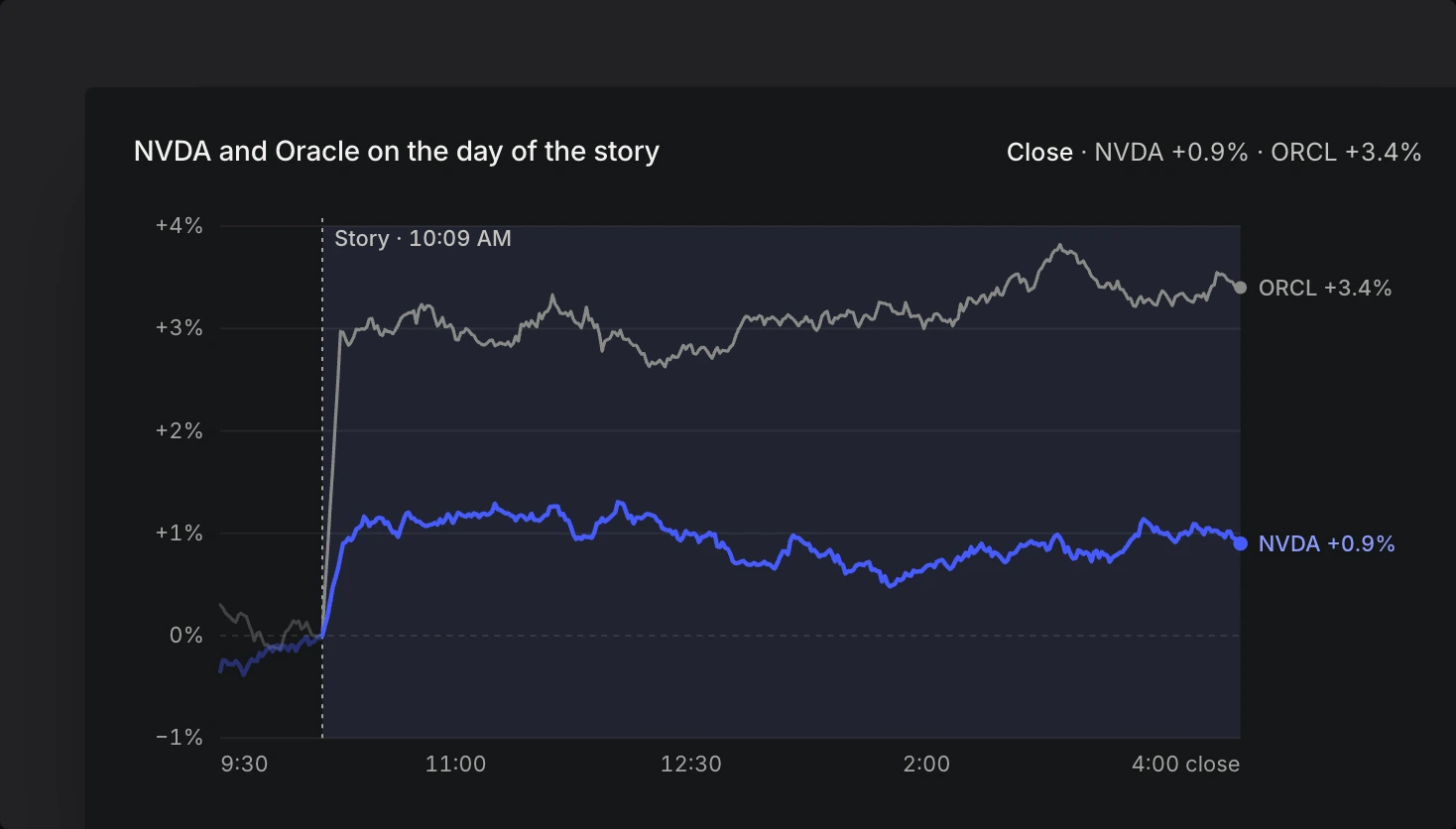
Note: One-minute prices on the day of the story. Example data, for illustration.
Source: Matterfact News
In the example, the company in the news closes up 3.4 percent and the covered name up 0.9 percent. The gap between the two is where the analyst's work begins: is the read-through priced, or is the market still making the connection?
Three moments in the day where read-throughs pay off
Before the open. See what happened since you last looked, and what to tell your PM. A line marks where you stopped reading, and unread headlines are set heavier, like mail.
During the session. The feed refreshes every minute while it is open, and new stories flash once as they land. When one of your names moves 3 percent or more, Matterfact offers to explain why.
Across the week. A heatmap shows where other companies' news has reached each of your names over the last seven days, and through which channels (Exhibit 5). Any cell narrows the feed to those stories.
Exhibit 5
A week of read-throughs shows which names other companies' news is reaching, and how.
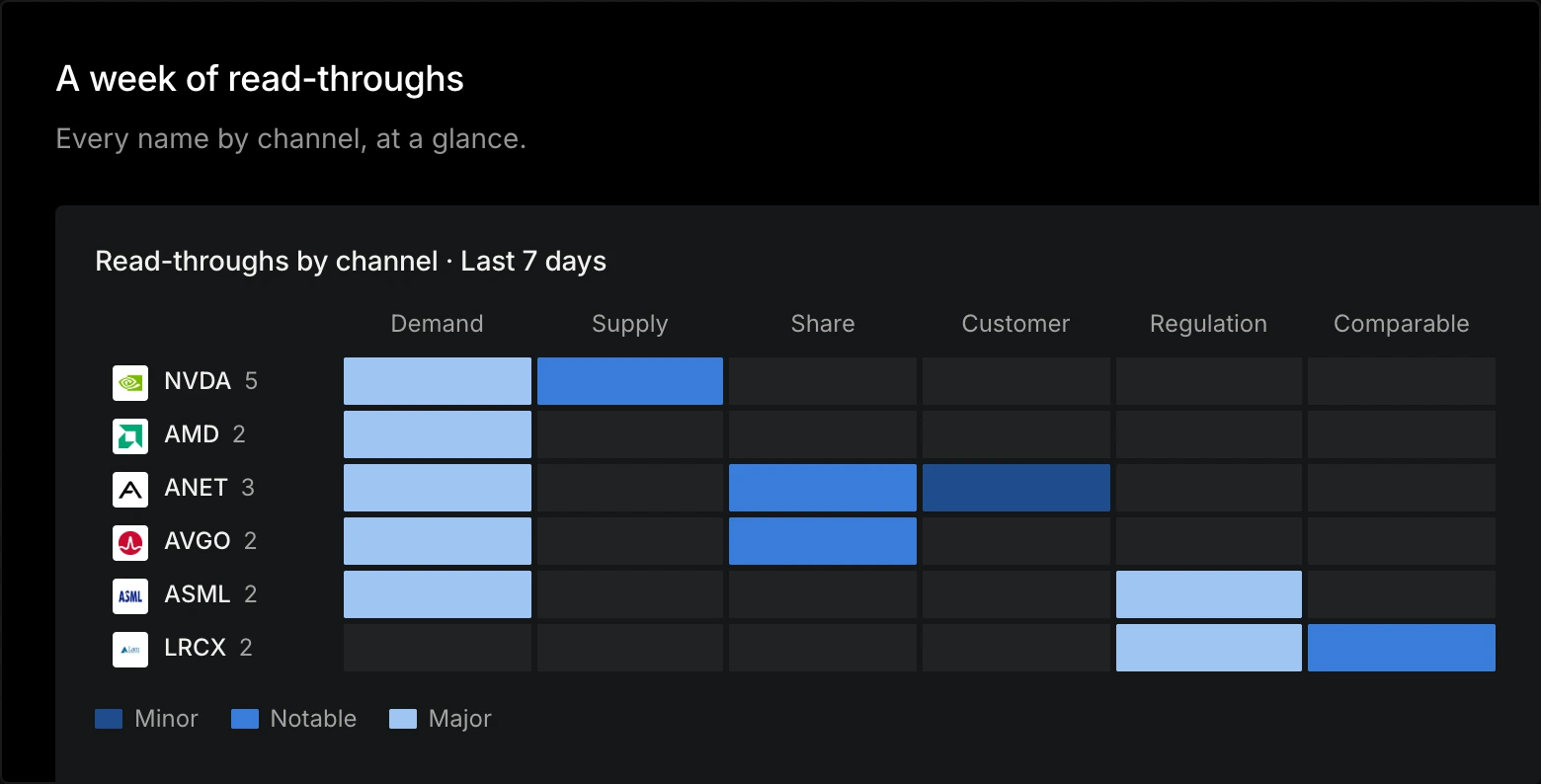
Note: Example data, for illustration.
Source: Matterfact News
Every story and every name also opens a chat that starts from what you are looking at, such as "What does this mean for NVDA?" or "Brief me on NVDA's news." The feed keeps 90 days of history, and search covers headlines, sources, channels, tickers and company names.
The edge is one link away
Every desk reads the headline about the company it covers. Fewer read the headline about that company's largest customer in time to act on it. The research says markets are slow to make that connection. The practical question is whether your team can make it faster.
Research leaders can ask themselves three questions:
- Which of our names are most exposed to news about other companies?
- How many of last quarter's surprises were visible one link away before they reached our stocks?
- How much of the team's reading time goes to stories that do not matter to the names we cover?
Read-throughs are built to answer the first two and to shrink the third, and they are live in Matterfact News today. Follow the companies you cover, and Matterfact maps the companies around them and reads every story on them for you.
Footnotes
-
Lauren Cohen and Andrea Frazzini, "Economic links and predictable returns," Journal of Finance, 2008, Volume 63, Number 4, pp. 1977–2011. ↩
-
Lior Menzly and Oguzhan Ozbas, "Market segmentation and cross-predictability of returns," Journal of Finance, 2010, Volume 65, Number 4, pp. 1555–1580. ↩
-
Charles M. C. Lee, Stephen Teng Sun, Rongfei Wang, and Ran Zhang, "Technological links and predictable returns," Journal of Financial Economics, 2019, Volume 132, Number 3, pp. 76–96. ↩
-
Usman Ali and David Hirshleifer, "Shared analyst coverage: Unifying momentum spillover effects," Journal of Financial Economics, 2020, Volume 136, Number 3, pp. 649–675. ↩
-
FASB Accounting Standards Codification 280-10-50-42, Information about major customers. See Deloitte, "Roadmap: Segment reporting, 5.7 Information about major customers." ↩